
My Child May Be at Risk for Dyslexia.
What Should I Do Next?
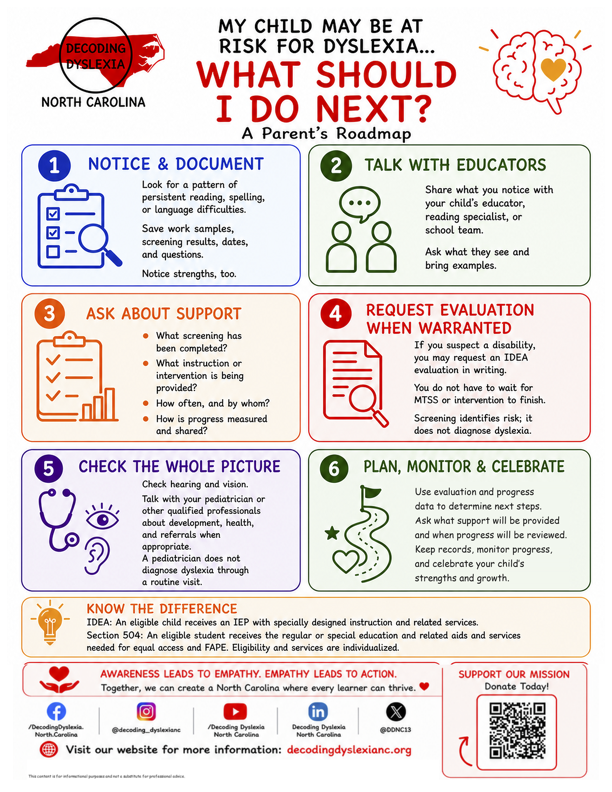
1. Notice and document
Look for difficulties that are persistent, unexpected, or different from those of other children receiving similar instruction.
Record what you notice, including:
Difficulty learning letter sounds
Trouble sounding out unfamiliar words
Slow, effortful, or inaccurate reading
Persistent spelling difficulties
Difficulty remembering sequences or following spoken directions
Avoidance, frustration, or anxiety related to reading and writing
Save work samples, screening results, report cards, teacher messages, intervention records, and notes from meetings. Include dates whenever possible.
Remember to document strengths, too. Children with dyslexia have individual patterns of strengths and needs.
2. Talk with your child’s educators
Share your concerns with your child’s teacher. You may also want to include a reading specialist, an interventionist, a school psychologist, a special education teacher, or an administrator.
Ask the school team:
What reading and spelling difficulties are you seeing?
What screening or assessment has been completed?
What instruction or intervention is being provided?
How often is the intervention provided?
Who provides it?
How is progress measured?
When will the team review the results?
Ask for specific examples and copies of available data. Bring your own notes and work samples to the conversation.
3. Understand screening, intervention, and evaluation
These terms are related, but they do not mean the same thing.
Screening
Screening is a brief process used to identify students who may be at risk or who may need additional instruction. Screening does not diagnose dyslexia and is not the same as a special education evaluation.
Federal regulations state that instructional screening is not an evaluation used to determine eligibility for special education. Read the IDEA regulation about screening.
Intervention
Intervention is additional targeted instruction provided to address an identified area of need. Schools may provide intervention through a Multi-Tiered System of Support, often called MTSS.
Ask what skills are being taught, what instructional approach is being used, how frequently instruction occurs, and how the school will measure your child’s response.
Evaluation
A comprehensive evaluation collects information from multiple sources to understand a child’s strengths, needs, educational performance, and possible disability.
IDEA requires schools to use a variety of assessment tools and strategies. A single score or test cannot be used as the sole basis for determining whether a child has a disability or what educational support is needed. Read the IDEA evaluation requirements.
An evaluation related to suspected dyslexia may examine areas such as:
Phonological awareness
Sound and symbol knowledge
Decoding of real and unfamiliar words
Word reading accuracy
Reading fluency
Spelling
Oral language
Reading comprehension
Memory and rapid naming when appropriate
Educational history, family history, and response to instruction
The International Dyslexia Association explains the purpose and common components of a dyslexia assessment in Dyslexia Assessment: What Is It and How Can It Help?.
4. Request an evaluation when warranted
Under IDEA, a parent or a public school agency may initiate a request for an initial evaluation. Read the federal IDEA regulation on initial evaluations.
In North Carolina, parents should submit the request in writing. If a parent needs assistance completing a written referral, the school must assist.
The request does not need to be complicated. Clearly state that you are requesting a comprehensive evaluation because you suspect your child may have a disability affecting reading, spelling, written language, or another area of educational performance.
Keep a dated copy of the request and a record of when the school received it.
North Carolina timeline
North Carolina generally requires the evaluation, eligibility decision, and, if the child is eligible, IEP development and placement to be completed within 90 calendar days after the school receives a written referral. Certain exceptions may apply.
See the North Carolina Policies Governing Services for Children with Disabilities for the complete requirements.
You do not have to wait for MTSS to finish.
A parent may request an initial evaluation at any time. A school may not require a child to complete MTSS or another intervention process before considering an evaluation when a disability is suspected.
The United States Department of Education states that MTSS may not be used to delay or deny a full and individual evaluation for a child suspected of having a disability. Read the federal Child Find guidance.
Intervention and evaluation can occur during the same period.
If the school declines the request
A parent’s request does not automatically require the school to evaluate. If the school does not suspect a disability and refuses the request, it must provide prior written notice explaining its decision, the information used to make the decision, and the parent’s procedural protections.
Parents may ask questions, provide additional information, request mediation or facilitation when available, file a state complaint, or use due process procedures.
5. Check the whole picture
Reading difficulty should not automatically be attributed to one cause. Hearing, vision, speech, language, attention, development, health, emotional well-being, and educational history may all be relevant.
Talk with your child’s pediatrician about developmental, health, hearing, vision, speech, language, or emotional concerns. A pediatrician can help identify medical or developmental issues and make appropriate referrals.
A routine pediatric visit does not replace a comprehensive educational or dyslexia evaluation. Dyslexia is not caused by poor eyesight, although a child can have both dyslexia and a vision condition.
The American Academy of Pediatrics encourages families to talk with both teachers and pediatricians when they have concerns about reading development. Read Reading Disorders: What Parents Need to Know.
6. Next steps
Evaluation results can lead to an individualized plan based on the child’s documented needs.
Ask the team:
What specific skills will be taught?
What instruction, accommodations, and services will be provided?
How frequently and for how long will services occur?
Who will provide the instruction?
How will progress be measured?
How often will the family receive progress information?
When will the team meet again to review the plan?
Continue to keep copies of evaluation reports, plans, progress reports, work samples, and communications with the school.
Progress may take time. Recognize effort, growth, interests, and strengths, as well as reading and spelling development.
Understanding IDEA and Section 504
IDEA and Section 504 are different federal laws. A child may qualify under one, both, or neither, depending on the individual evaluation and eligibility criteria.
IDEA
A child who is eligible under the Individuals with Disabilities Education Act receives an Individualized Education Program, commonly called an IEP.
An IEP may include specially designed instruction, related services, accommodations, measurable annual goals, and a plan for monitoring progress.
Dyslexia may be identified within the IDEA eligibility category of Specific Learning Disability when the required criteria are met.
Section 504
Section 504 protects qualified students with disabilities from discrimination and ensures equal access to educational opportunities.
An eligible student may receive regular or special education, along with related aids and services, designed to meet the student’s individual educational needs. Eligibility and services must be determined individually.
A medical diagnosis alone does not automatically establish Section 504 eligibility, and a medical diagnosis is not always required. The school must consider information from a variety of sources.
Learn more through the United States Department of Education Section 504 Frequently Asked Questions.
What happens if my child is not found eligible?
Not every child with dyslexia or reading difficulties will qualify for an IEP or a Section 504 plan. Eligibility is based on the individual evaluation and the requirements of each law.
If your child is not found eligible, ask the school to explain the decision and provide it in writing. Review the evaluation results, the information the team considered, and the eligibility criteria used.
Parents can also ask:
What general education instruction or intervention will be provided?
Which specific reading and spelling skills will be addressed?
Who will provide the instruction?
How often and for how long will it occur?
How will progress be measured and shared?
When will the team review the child’s response?
Continue documenting concerns, work samples, intervention records, progress data, and communication with the school.
If you disagree with the school’s evaluation, you may request information about an Independent Educational Evaluation. North Carolina policies explain that a parent may request an Independent Educational Evaluation at public expense when the parent disagrees with an evaluation conducted by the school. The school must then, without unnecessary delay, either provide the evaluation at public expense or request a due process hearing to defend its evaluation.
Families may also ask about mediation, state complaint procedures, due process, and other procedural safeguards. These options have different purposes and requirements, so families may wish to consult a parent center, advocate, or attorney regarding their individual circumstances.
Learn more
North Carolina Policies Governing Services for Children with Disabilities
This is the official North Carolina policy document. Sections on evaluations, eligibility determinations, Independent Educational Evaluations, prior written notice, and procedural safeguards are especially relevant.
Duke Children’s Law Clinic: A Parents’ Guide to Special Education in North Carolina
This parent-friendly guide explains North Carolina special education procedures, evaluations, eligibility, IEPs, dispute resolution, Section 504, and sample letters in clearer language.
This information is provided for educational purposes and is not legal advice.
Helpful North Carolina resources
ECAC IEP Road Map
The Exceptional Children’s Assistance Center created an IEP Road Map to help North Carolina families understand the sections of an IEP and participate more confidently in the IEP process.
View the 2026 ECAC IEP Road Map PDF
North Carolina procedural safeguards
The North Carolina Notice of Procedural Safeguards explains parent rights related to evaluation, eligibility, records, disagreements, complaints, mediation, and due process.
Read Parent Rights and Responsibilities in Special Education
A sample written evaluation request
Parents may adapt the following language:
Date:
Dear:
I am requesting a comprehensive initial evaluation under the Individuals with Disabilities Education Act for my child, ____________________.
I am concerned about persistent difficulties with ____________________. I suspect that my child may have a disability affecting educational performance.
Please consider all areas related to the suspected disability, including reading, decoding, fluency, spelling, written language, oral language, and any other relevant areas.
Please provide me with information about the next steps, the proposed evaluation plan, my consent rights, and a copy of the procedural safeguards.
Thank you,
Parent or guardian name:
Contact information:
Sources and further reading
IDEA Regulation 34 CFR 300.302: Screening Is Not an Evaluation
North Carolina Policies Governing Services for Children with Disabilities
North Carolina Parent Rights and Responsibilities in Special Education
United States Department of Education: Section 504 Frequently Asked Questions
This information is provided for educational purposes. It is not a screening, diagnosis, medical advice, or legal advice. Requirements and individual circumstances may vary. Families should consult qualified professionals or appropriate agencies regarding individual needs.

ECAC has shared this great IEP Road Map resource. Click to learn more!
In addition, here is an excellent explanation of the difference between a Medical/Clinical Diagnosis and Eligibility for Special Education Medical/Clinical Diagnosis VS Special Education Eligibility