

What Are Decodable Books?
Decodable books are texts designed to give beginning and struggling readers opportunities to practice the sound-spelling relationships they have already been taught.
Rather than relying on pictures, context, or memorization to identify unfamiliar words, children practice looking at the letters in a word, connecting them with sounds, and blending those sounds together to read the word.
As children learn more phonics patterns, the texts they can successfully decode become increasingly complex.
Why Are Decodable Books Helpful?
Learning a phonics skill during a lesson is only the beginning. Children also need opportunities to apply that skill while reading connected text.
Well-matched decodable text gives developing readers opportunities to:
practice recently taught sound-spelling relationships;
develop accurate decoding habits;
build automatic word recognition through repeated successful encounters with words;
increase reading accuracy and fluency; and
experience the success of actually reading a text themselves.
Decodable text is especially useful during the period when children are learning the alphabetic code and for older students who still need explicit instruction and practice with decoding.
The goal is not for students to read only decodable books forever. As decoding becomes increasingly accurate and automatic, students can successfully read a much wider range of texts.
One Important Rule: Match the Book to the Reader
A book is only truly decodable for a child if the child has been taught the sound-spelling patterns needed to read it.
A child who has learned short vowels and a few consonant digraphs, for example, should not be expected to independently read a “decodable” book filled with vowel teams and advanced spelling patterns.
If your child's school uses a systematic phonics program, ask the educator:
“What phonics patterns has my child learned so far?”
Then look for decodable texts that provide practice with those skills.
Find FREE Decodable Books & Texts
UFLI Foundations — Free Decodable Passages
The University of Florida Literacy Institute provides free decodable passages organized according to its systematic phonics sequence. Collections are available for kindergarten, first grade, and second grade, along with supplemental passages. This is particularly useful when you know which phonics skill your child needs to practice. UFLI makes these materials freely available for educational use and provides grade-organized collections. Explore UFLI's free printable resources
Reading Universe — Free Decodables
Reading Universe offers more than 95 free decodable texts organized by phonics skill. The collection is designed so the texts can be used alongside different phonics curricula rather than requiring one particular program. Teach My Kid To Read
Best for: beginning and developing readers who need targeted practice with specific phonics patterns.
I See Sam — Free E-Books
The I See Sam beginning-reading series includes free e-books for emergent readers. The books build cumulatively as students develop decoding skills. Teach My Kid To Read
Best for: emergent readers who are just beginning to develop independent decoding.
Circle Decodables
The Children's Learning Institute at UTHealth Houston provides free e-books, with print versions also available for purchase. The texts are intended for beginning or struggling readers and build cumulatively. Teach My Kid To Read
Decodable Book Finder
Teach My Kid to Read maintains a searchable database of 196 decodable collections. Families and educators can filter the collection by reader group and language. Teach My Kid To Read
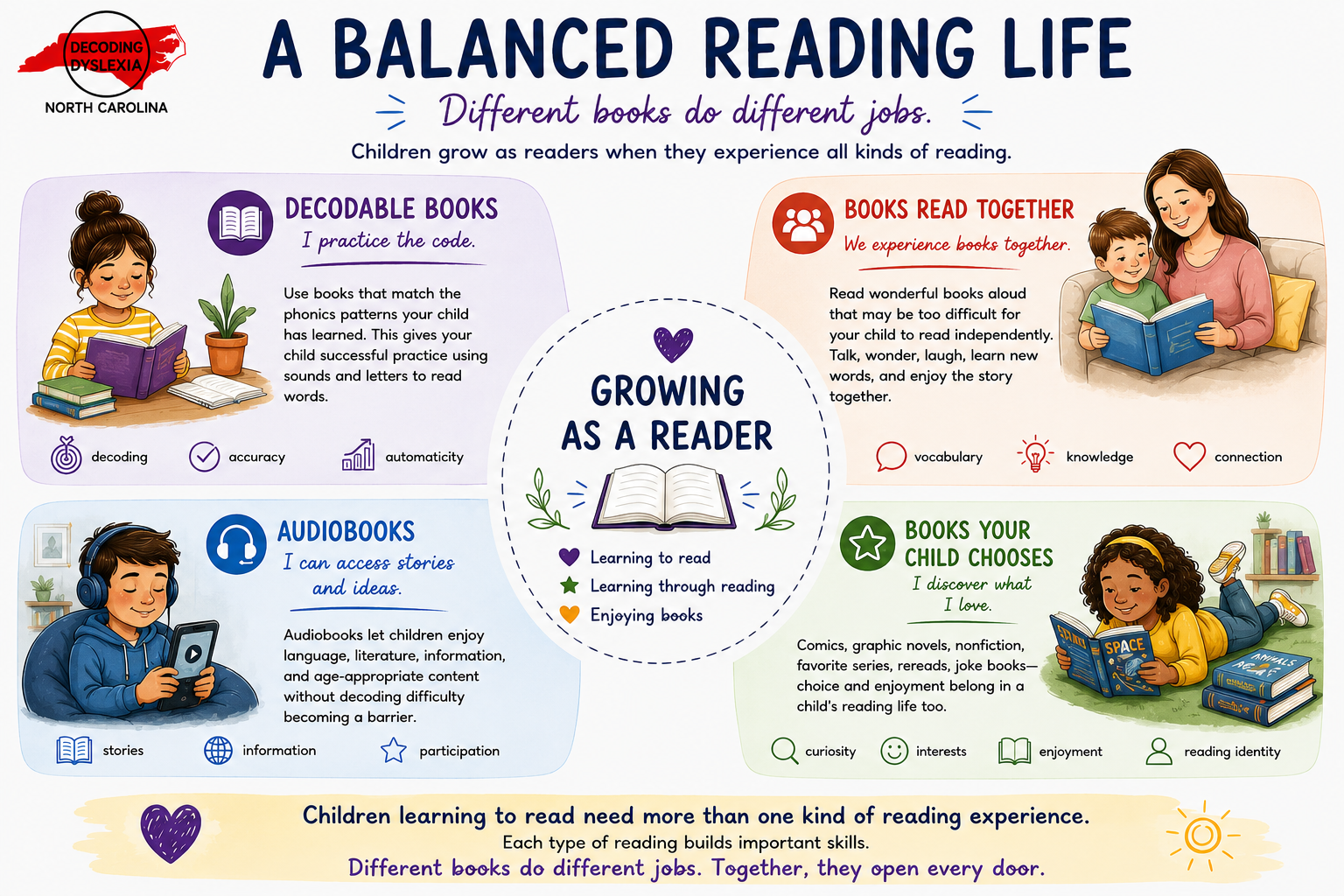
Decodable Books Are Only One Part of a Rich Reading Life
Keep reading wonderful books to your child.
Decodable texts serve a specific instructional purpose: they allow children to practice applying the alphabetic code while developing word-reading skills.
They do not replace:
family read-alouds;
children's literature;
audiobooks;
opportunities to build vocabulary and knowledge;
conversations about interesting ideas and stories; or
access to grade-level content.
A child may be developing decoding skills while having sophisticated interests, vocabulary, reasoning, and comprehension. Difficulty reading a book independently should never limit the ideas, stories, and knowledge a child can access.