Signs of Dyslexia
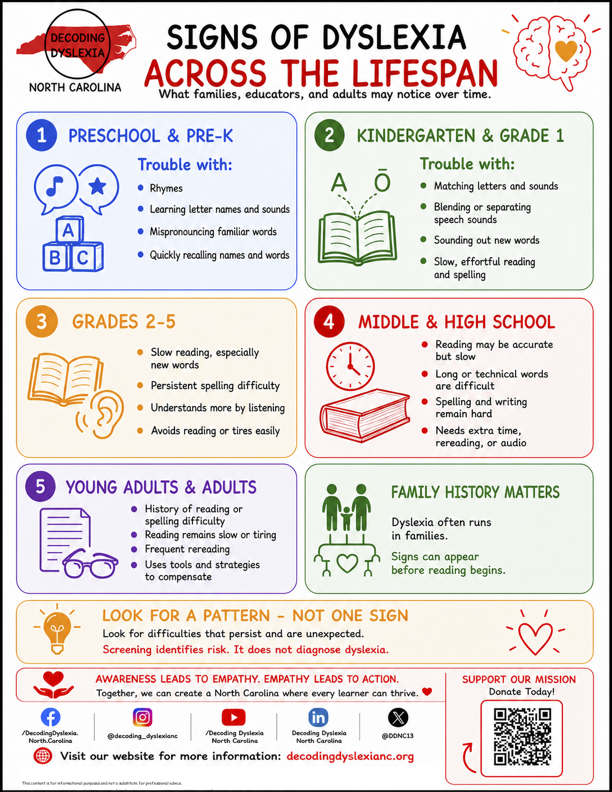
Dyslexia can look different as a person grows and the demands of reading, writing, school, work, and daily life change.
Signs may appear before a child begins to read. Some become more noticeable when formal reading instruction begins, while others emerge later as texts become longer and more complex.
One sign by itself does not mean that a person has dyslexia. Look for a pattern of persistent, unexpected difficulty—especially difficulty that continues despite appropriate instruction and support.
Understanding the Signs
Dyslexia primarily affects the development of efficient word reading and spelling. Depending on the person’s age, signs may also appear in related skills such as recognizing speech sounds, learning letter-sound relationships, sounding out unfamiliar words, reading fluently, retrieving words, and managing written work.
The signs change over time because the demands change. A preschool child is not expected to read independently so early clues may involve spoken language, rhyming, and learning letters. An adult may read accurately but still read slowly, reread frequently, avoid reading aloud, or rely heavily on technology and other strategies.
Preschool and Pre-K
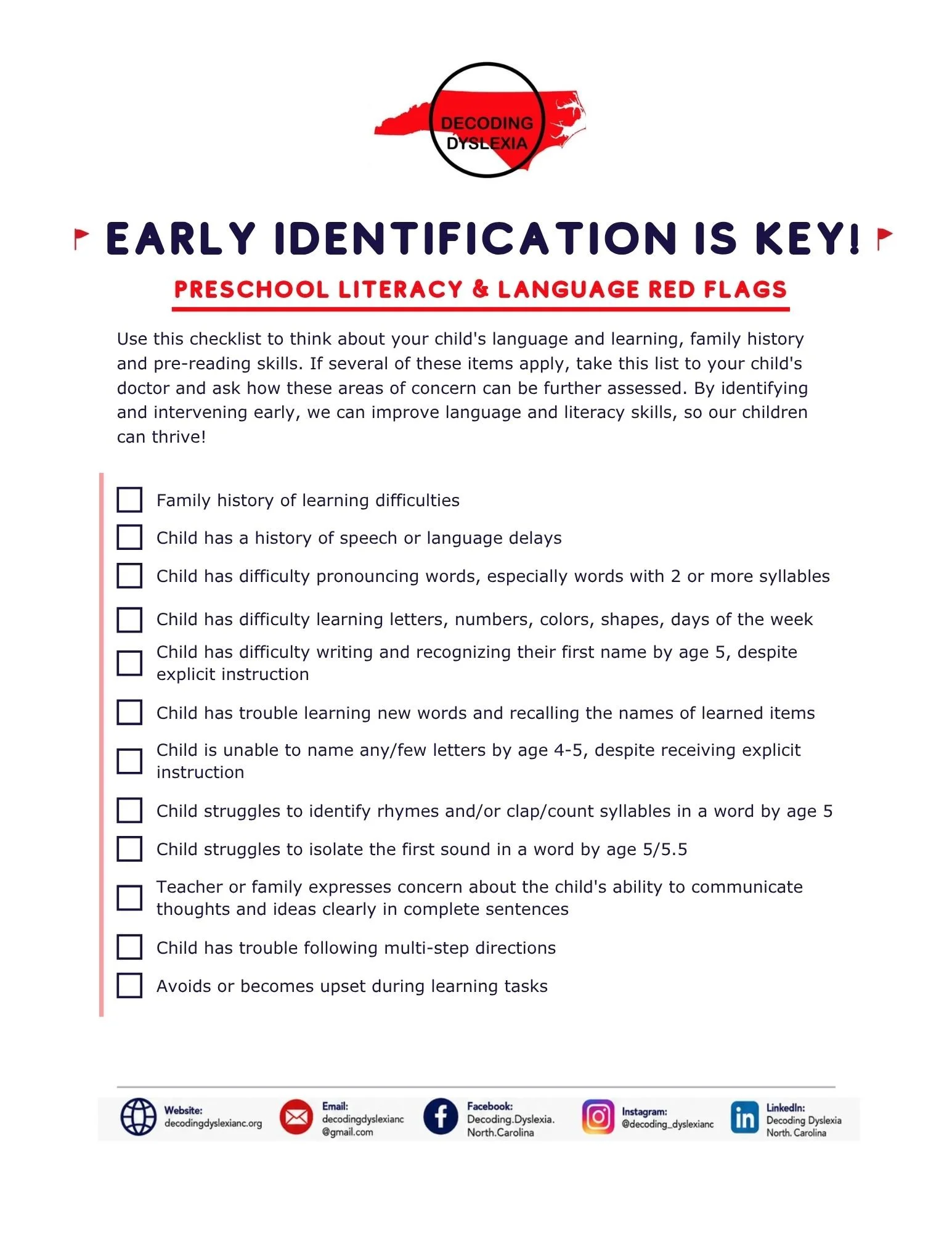
Before formal reading instruction begins, signs may appear in a child’s development of spoken language and early literacy skills.
Families and educators may notice difficulty with:
Recognizing or producing rhymes
Learning and remembering letter names and sounds
Pronouncing familiar words clearly
Quickly recalling familiar names or words
Learning sequences, such as the alphabet
Remembering information such as colors, names, or familiar labels
These difficulties are not necessarily caused by dyslexia. However, several signs occurring together—particularly when there is a family history of reading or spelling difficulty—may indicate an increased risk for later reading problems.
Explore preschool signs and early reading skills — Yale Center for Dyslexia & Creativity.
Kindergarten and Grade 1
During kindergarten and first grade, children begin learning how spoken sounds connect with printed letters and words. Dyslexia-related difficulties often become more noticeable during this stage.
Families and educators may notice difficulty with:
Matching letters with their sounds
Identifying, blending, or separating sounds in spoken words
Sounding out unfamiliar words
Remembering words that have already been practiced
Developing accurate spelling
Reading simple text without excessive effort, guessing, or frustration
A child may have a strong vocabulary, understand stories read aloud, and demonstrate knowledge in many areas while still having significant difficulty learning to read words.
Screening can identify children who may be at risk and need additional instruction. Children do not need to experience years of reading failure before concerns are taken seriously. The International Dyslexia Association recommends early universal screening using measures related to phonological awareness, letter knowledge, rapid naming, word recognition, and other predictors of reading development.
Grades 2–5
As students move from learning to read toward reading to learn, difficulties may become more apparent across subjects.
Families and educators may notice:
Slow or effortful reading
Difficulty sounding out unfamiliar or longer words
Persistent spelling difficulty
A need to reread instructions or passages
Stronger understanding when information is presented orally
Avoidance, frustration, or fatigue related to reading
Difficulty completing reading and writing assignments within the expected time
Some students develop strategies that make their difficulties less visible. They may memorize familiar words, rely on pictures or context, choose books they already know, or compensate through strong reasoning and listening skills. These strategies can help a student function, but they do not necessarily mean that the underlying reading difficulty has disappeared.
Middle and High School
Older students with dyslexia may become more accurate readers while continuing to read slowly and with considerable effort.
Signs may include:
Difficulty reading multisyllabic, technical, or unfamiliar words
Slow reading despite adequate understanding
Persistent spelling and written-expression difficulty
Frequent rereading
Difficulty taking notes while listening
Needing substantially more time for reading and writing
Heavy reliance on audiobooks, text-to-speech, speech-to-text, or other supports
Avoidance of reading aloud
Fatigue or anxiety related to large reading assignments
A student’s grades may not fully reflect the effort required. Some students spend far more time studying than their peers or sacrifice sleep, activities, and social time to keep up.
Young Adults and Adults
Dyslexia is lifelong, although its effects can change with instruction, experience, technology, and the demands of a person’s environment.
Adults may recognize:
A childhood history of reading or spelling difficulty
Slow or tiring reading
Frequent rereading
Persistent spelling difficulty
Difficulty reading aloud
Trouble quickly retrieving names or words
Avoidance of reading-heavy tasks
Reliance on audiobooks, spell-check, speech-to-text, templates, or other strategies
Needing additional time for tests, paperwork, or workplace reading
Using tools and strategies is not a weakness. These supports can provide equitable access and allow individuals to demonstrate their knowledge more efficiently.
Adults who want to explore their own reading history may find IDA’s self-assessment helpful as a starting point. It is not a diagnosis.
Explore IDA’s Adult Dyslexia Self-Assessment
Family History Matters
Dyslexia often runs in families. A history of reading, spelling, speech-language, or school difficulties in a parent or close relative is important information to share during screening or evaluation.
Family history does not determine with certainty that a child will have dyslexia. It does mean that early language and literacy development should be monitored carefully.
IDA recommends including family history when considering a child’s risk for reading difficulty.
Learn about preschool risk and family reading history — International Dyslexia Association.
Look for a Pattern, Not One Sign
Many individual signs of dyslexia can occur for other reasons. A young child may mispronounce words, an older student may dislike reading, and an adult may occasionally struggle to retrieve a name.
Concern increases when difficulties arise:
Occur together in a recognizable pattern
Persist over time
Are unexpected in relation to the person’s other abilities
Continue despite appropriate instruction and practice
Interfere with school, work, or everyday activities
Require significantly greater time or effort than expected
A checklist can help families and educators organize observations, but it cannot diagnose dyslexia.
Screening Is Not the Same as Evaluation
Screening identifies risk. It does not diagnose dyslexia.
A screening is generally a brief assessment used to determine whether a student may be at risk for reading difficulties and may need closer monitoring, additional instruction, or further assessment.
A comprehensive evaluation gathers information from multiple sources. Depending on the person and the purpose of the evaluation, it may examine developmental and educational history, family history, oral language, phonological processing, decoding, word reading, reading fluency, spelling, comprehension, written language, and response to instruction.
An evaluation should help answer three questions:
Why is this person having difficulty?
What are the person’s specific strengths and needs?
What instruction, services, accommodations, or supports may be appropriate?
Learn about testing and evaluation — International Dyslexia Association
Explore the IDA Dyslexia Assessment Guidelines
What About Multilingual Learners?
Learning more than one language does not cause dyslexia.
When a multilingual learner has persistent literacy difficulty, screening and evaluation should consider:
The languages the student speaks and reads
The language of instruction
The quality and length of literacy instruction received
Progress compared with peers who have similar language backgrounds
Reading and writing development across languages
Family and developmental history
Core literacy skills such as phonological awareness, decoding, fluent word recognition, and spelling
The goal is to distinguish the normal process of learning an additional language from a reading difficulty that appears across languages and contexts.
Read English Learners and Dyslexia — International Dyslexia Association
What Should I Do If I Notice Several Signs?
You do not need to diagnose dyslexia before raising a concern.
Helpful first steps include:
Write down the specific patterns you are noticing.
Gather examples of reading, spelling, or written work.
Ask the educator what they are observing.
Review screening and progress-monitoring results.
Ask what reading instruction or intervention is being provided.
Monitor whether the person is making adequate progress.
Request additional screening or a comprehensive evaluation when concerns persist.
Do not wait for a child to fail before asking questions.
Next in the DDNC Quick Guide Series: My Child May Be at Risk for Dyslexia—What Should I Do? →
Watch: Early Clues
Dr. Sally Shaywitz of the Yale Center for Dyslexia & Creativity explains early signs of dyslexia and why early identification matters.
Watch Early Clues — Yale Center for Dyslexia & Creativity
Trusted Resources
Yale Center for Dyslexia & Creativity — Signs of Dyslexia
A developmental overview of signs from preschool through adulthood.
Explore signs across the lifespan.
International Dyslexia Association — Universal Screening: K–2 Reading
Explains the purposes of screening, skills commonly assessed, and the importance of early identification.
Learn about universal screening.
International Dyslexia Association — Testing and Evaluation
Explains how evaluation differs from a single test and what information an evaluation should provide.
Learn about evaluation
International Dyslexia Association — Assessment Guidelines
A detailed, research-based framework for dyslexia assessment across languages and cultural contexts.
Explore the assessment guidelines.
International Dyslexia Association — English Learners and Dyslexia
Guidance for screening and evaluating students who are developing literacy in more than one language.
Read the fact sheet
Yale Center for Dyslexia & Creativity — Reading-Related Skills
Developmental reading-related accomplishments that can help families understand what children typically learn during the preschool and early school years.
Explore reading-related skills